The battery life of a battery-powered sensor is often presented as a simple feature: 3 years, 5 years or more. Yet, this value alone does not allow us to anticipate the operational reality of a fleet of sensors.
In practice, the actual range depends on many technical and environmental factors, and can vary from one sensor to another.
Why does the autonomy vary naturally ?
Several factors influence the lifespan of a sensor :
the battery itself
- manufacturing tolerances,
- natural ageing,
- conditions of stockage.
electronic design
- communication protocol used,
- frequency and volume of transmissions,
- energy optimization of components.
terms of use
- temperature,
- intensity of use,
- real environment, often more demanding than the test conditions.
These factors create a natural dispersion of autonomies within the same batch.
A statistical reality : not all sensors age at the same rate
The autonomy of a set of sensors generally follows a statistical distribution called the normal law or “bell curve”.
That means :
- some sensors will work longer than the average,
- some will break down earlier,
- the majority (68%) will be around the advertised lifespan.
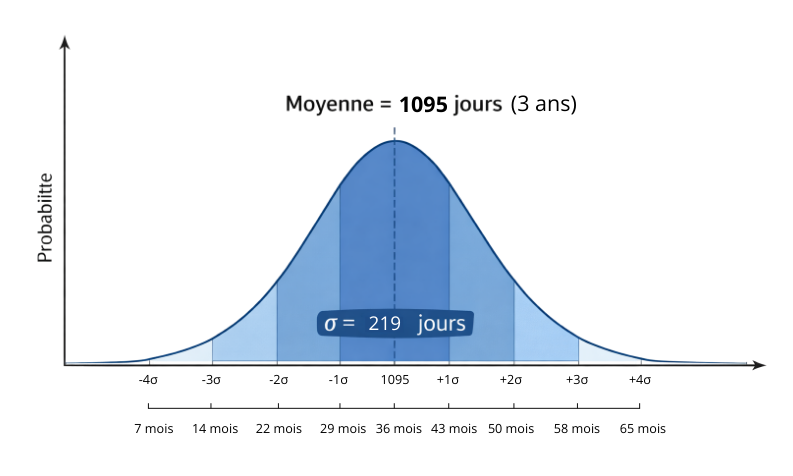
The graph below represents a typical example of a batch of 1000 bluetooth sensors announced with an average battery life of 3 years.
On this curve :
- The average lifespan is 1,095 days (3 years)
- The first sensors will fail before 15 months.
- After 2 years, around 13 sensors will fail every day, and this number will increase very quickly.
- 200 sensors will not reach 2 years !
- And 500 sensors will have been changed/repaired before 3 years… at least once
What if we apply this reasoning to sensors with a longer lifespan?
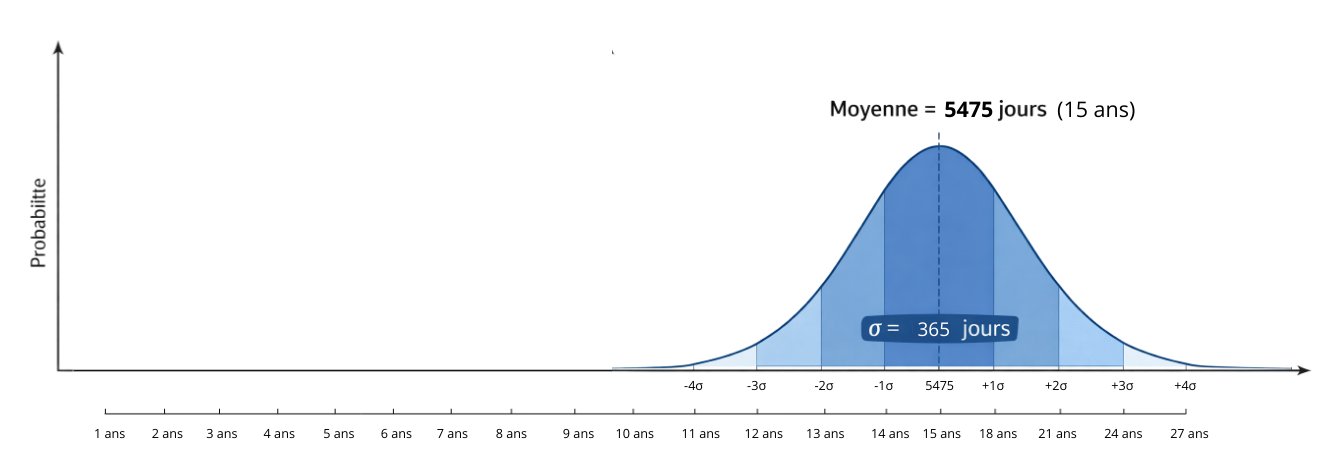
Let’s now assume that the Superwyze sensors have a dispersion comparable to that of competing sensors shown on the previous curve.
The major difference is that the average lifespan of Superwyze sensors can reach 15 years, which is about 12 years longer than typical sensors advertised at 3 years.
In this case, the statistical curve would remain globally the same, but simply shifted to the right by about 12 years.
In other words :
- the first replacements would take place after about ten years of use,
- the majority of sensors would operate for nearly fifteen years,
This difference completely changes the operational reality of a sensor park.
Actual battery life : a key factor in the total cost of ownership
The real issue is not only the announced value, but also the stability and the actual life span over time.
Plus l’autonomie est longue, plus les bénéfices sont importants :
- reduce maintenance operations
- decrease in intervention costs
- improvement of service continuity
- increased system reliability
Conversely, limited autonomy requires frequent replacement cycles, which generate significant human and financial costs.
A different approach : prioritizing sustainability from the design stage
At Superwyze, the sensors are designed with a fundamentally different approach: maximizing lifetime and stability over time.
With a battery life of up to 15 years, they can :
- drastically reduce maintenance interventions
- ensure service continuity in the long term
- to secure critical operations
- significantly reduce the total cost of ownership
This performance is based on :
- advanced optimization of energy consumption
- effective communication protocols
- a robust electronic design
- technological choices oriented towards sustainability
Conclusion
The autonomy of a sensor should not be considered as a simple technical data, but as a key indicator of reliability and operational performance.
Choosing a solution with high and stable autonomy not only reduces maintenance costs, but also ensures the continuity and reliability of the system in the long term.
In reality, a solution requiring regular replacements is simply not viable !
To go further
Variations in energy consumption are not limited to IoT sensors. They are also observed on consumer devices, even though they come from the same model and the same production series.
A study conducted on identical smartphones shows significant differences in energy consumption between devices, confirming that performance dispersions are an inevitable reality of electronic systems.